
Updated October 18, 2026. Costs are broad ranges from published sources and vary a lot by region and design. Use them for budgeting and get local quotes.
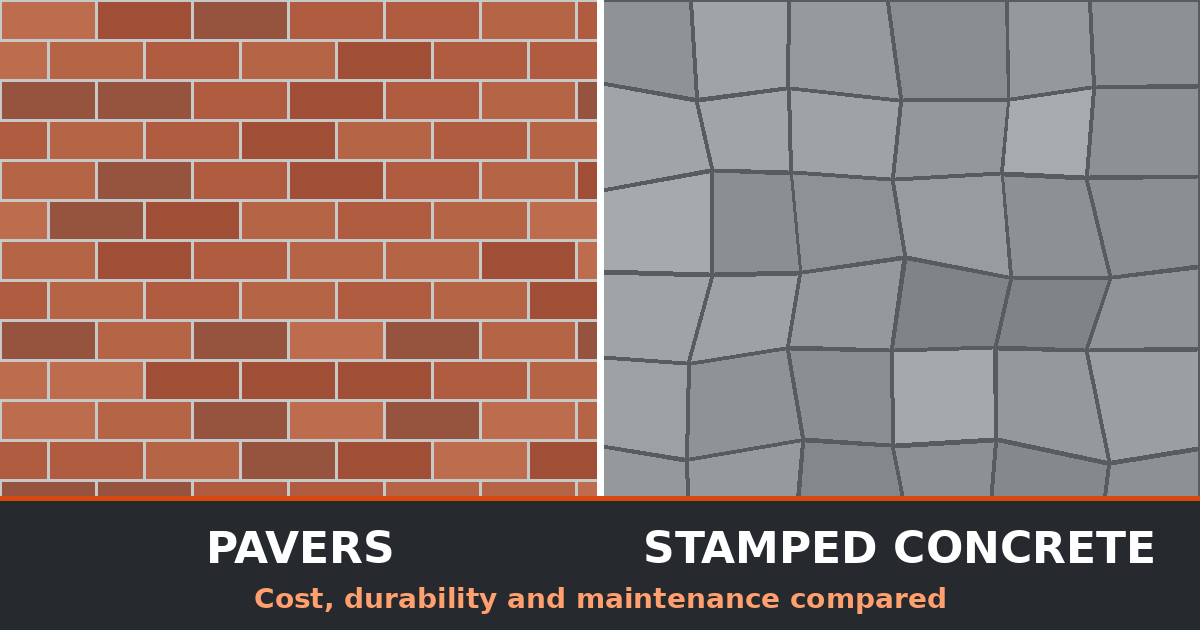
Short answer: stamped concrete is usually cheaper upfront and gives a seamless surface, while pavers cost more at first but are easier to repair and often last longer. For a patio you want to keep for 15+ years, repair cost matters as much as price.
Quick comparison
| Stamped concrete | Pavers | |
|---|---|---|
| Typical installed cost | about $8 to $25 per sq ft | about $10 to $35 per sq ft |
| Repairs | Cracks are patched; hard to match color | Replace single pavers |
| Maintenance | Reseal every 2 to 3 years | Refill joint sand, control weeds, reseal if wanted |
| Cracking | Likely over time | Rare, but can settle or shift |
| DIY friendly | No | Yes, with effort |
Cost per square foot: what the sources say
Published numbers disagree. A well-known home-cost guide lists basic stamped concrete from about $5 to $18 per sq ft and pavers from about $8 to $50. Contractor guides for 2026 give wider ranges, roughly $8 to $28 for stamped concrete and $10 to $50 for pavers. At the budget end stamped is cheaper, but for detailed patterns, borders and colors the two often end up close.
Example: a 20x20 ft patio (400 sq ft)
| Option | Rough installed range |
|---|---|
| Stamped concrete ($8 to $25) | $3,200 to $10,000 |
| Pavers ($10 to $35) | $4,000 to $14,000 |
These are examples, not quotes. For stamped concrete you can estimate the concrete itself: 20 x 20 ft at 4 in thick is about 133 cubic feet, or 4.94 cubic yards, and about 5.4 yards with 10% extra. Check your own size with the slab calculator. Remember the quantity covers concrete only. Pavers need a compacted gravel base (commonly 4 to 6 in for patios) and bedding sand, which are separate costs.
Long-term cost, not just upfront
- Stamped concrete: resealing every 2 to 3 years at roughly $0.50 to $1.50 per sq ft, plus crack repair that rarely matches the color.
- Pavers: sealing is optional and costs about the same per sq ft, and you may need to re-level sunken areas or refill joints.
Several cost guides conclude that over 10 to 20 years the gap narrows to within about 5 to 10 percent, so a cheaper start does not always mean a cheaper decade.
Durability and cracking
Stamped concrete is a slab. It can crack from shrinkage, a weak base or freeze-thaw cycles, and the pattern makes cracks stand out. Control joints, proper thickness and a good base reduce the risk. Pavers are flexible, so they tolerate ground movement better, but they can settle or shift if the base is poor. See the slab thickness guide before you pour.
Around a pool
Pavers are common on pool decks because they are easy to repair and light colors stay cooler under bare feet. Stamped concrete can work too, but sealed surfaces get slippery when wet, so ask for a slip-resistant sealer or additive. Either way, make sure the surface slopes away from the pool for drainage.
Climate and winter
In freezing climates, pavers flex with frost movement. A stamped slab needs proper air-entrained concrete and good timing. If you plan a winter pour, read pouring concrete in cold weather. Stamped concrete also needs time to cure before sealing: how long concrete takes to cure.
What homeowners complain about
- Stamped concrete: cracks, color fading, slippery sealer and expensive patch repairs.
- Pavers: weeds in joints, sinking spots, ants and the need to refill sand.
Which should you choose?
| Choose stamped concrete if | Choose pavers if |
|---|---|
| You want a seamless look and lower upfront cost, and accept occasional cracks. | You want easier repairs, plan to stay long term, or have shifting soil. |
| The area is a regular shape and easy to access. | You want to DIY or phase the project. |
How to compare quotes near you
- Get at least three itemized quotes for the same size and thickness.
- Ask about base depth, drainage, control joints, sealer type and warranty.
- Ask what repair looks like in five years.
Planning the slab itself? Start with how much concrete you need for a patio or the main concrete calculator.
Sources used for cost ranges
Bob Vila (cost of pavers vs concrete), InstallItDirect (San Diego comparison, 2026) and UseCalcPro (stamped concrete vs pavers cost, 2026). Prices and claims vary by source and region.
Frequently asked questions
Is stamped concrete cheaper than pavers?
Usually yes at the basic end, but not always. Published ranges overlap heavily (roughly $8 to $25 per sq ft for stamped concrete and $10 to $35 for pavers), and complex patterns can make stamped concrete cost as much as pavers. Always compare itemized local quotes.
Which lasts longer, pavers or stamped concrete?
Pavers are often claimed to last longer because individual units can be lifted and reset, while a cracked slab must be patched or replaced. Many paver contractors quote 30 to 50 years versus 15 to 25 for stamped concrete, but results depend on installation and climate.
Is stamped concrete or pavers better around a pool?
Both work. Pavers can be easier to repair and stay cooler in lighter colors. Stamped concrete needs a slip-resistant sealer or additive because sealed surfaces can be slippery when wet. Ask your installer about texture and drainage.
Does stamped concrete crack?
Any concrete can crack. Proper base preparation, control joints and thickness reduce the risk, but they do not remove it. Cracks in stamped concrete are harder to hide than in plain concrete.
Can I install pavers myself?
Many homeowners do, since pavers go in piece by piece over a compacted base. Stamped concrete is best left to professionals because the stamping must happen within a short window while the concrete is still workable.